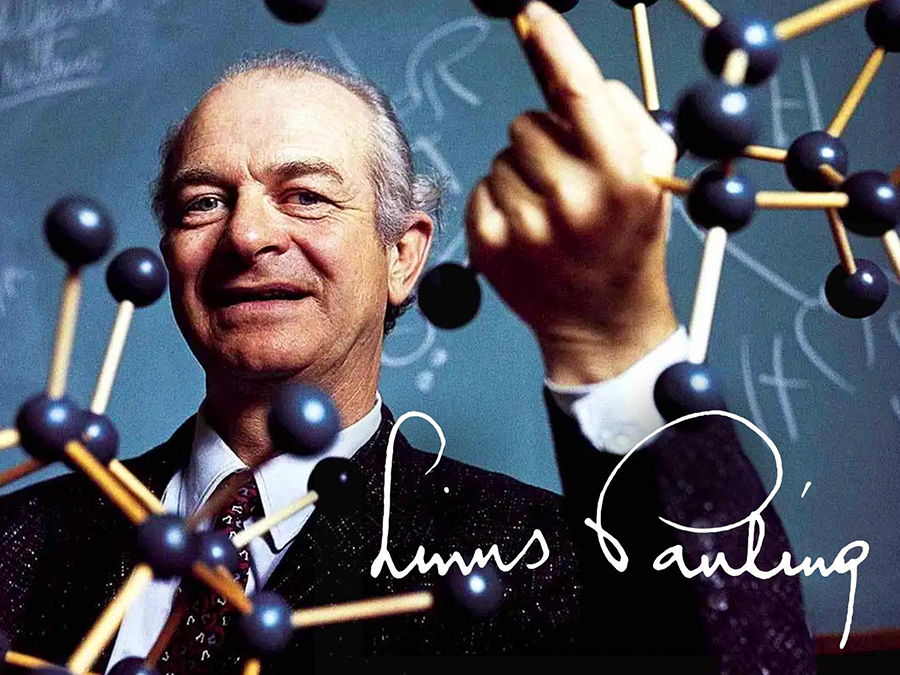
Linus Pauling was born in Portland, Oregon, in 1901, the son of a druggist who died young and a mother who struggled to keep the family afloat. He paid his own way through Oregon Agricultural College with laborer’s wages, published his first paper — on the crystal structure of molybdenite — before he had finished his doctorate, and arrived at the California Institute of Technology in 1925 to begin a thirty-eight-year residency that would remake the science of matter itself.
What Pauling did, in essence, was teach chemistry to see. Borrowing the new language of quantum mechanics from Sommerfeld, Bohr, and Schrödinger, he explained why atoms hold together at all. His electronegativity scale gave chemists a number for an atom’s hunger for electrons; his valence bond theory and his 1931 papers on the nature of the chemical bond reorganized the discipline around the geometry of molecules. By 1954 the Royal Swedish Academy had awarded him the Nobel Prize in Chemistry for his work. Along the way he had described the alpha helix coiling through proteins, identified sickle-cell anemia as the first “molecular disease,” and laid groundwork so fundamental that Francis Crick would later call him the father of molecular biology.
A lesser figure might have stopped there, content to be ranked among the greatest chemists since Lavoisier. Pauling could not. He had spent the 1940s close enough to the atomic project to understand exactly what physics had handed the generals, and in the aftermath of Hiroshima he refused the comfortable silence available to a celebrated laureate. With his wife and closest collaborator, Ava Helen, he began to speak — first to citizens’ committees, then to the world — about radioactive fallout, about strontium settling in the bones of children, about the genetic damage that open-air testing scattered indiscriminately across the planet. He marshaled data the way he marshaled molecules, and in 1958 he carried to the United Nations a petition signed by more than 9,000 scientists demanding an end to nuclear tests.
The personal cost was real. His passport was withheld. The FBI took an interest. The California Institute of Technology, uneasy with its most famous and most inconvenient professor, offered no celebration when the second prize came — in October 1963 the Nobel committee named Pauling its Peace laureate — making him the only person in history to hold two unshared Nobel Prizes. On the very day the award was announced, the Partial Nuclear Test Ban Treaty entered into force. The argument he had made with statistics had become international law.
This is the type of person and work that the World Academy of Art and Science (WAAS) was built to attract The Academy was founded in 1960 by scientists and thinkers who had watched humanity acquire the means of its own extinction and resolved to do something about it. Einstein was called its spiritual father; J. Robert Oppenheimer, Bertrand Russell, and Joseph Rotblat were among the minds who shaped its founding concern — that science, unmoored from ethics, could become an instrument of annihilation. WAAS was conceived as an informal world association answerable to the highest scientific and moral standards, a forum where knowledge could be weighed against conscience independent of borders and prevailing orthodoxies.
Pauling belonged in that company as naturally as carbon belongs in a chain. His name sits among many of the Academy’s most distinguished Fellows, and his archive at Oregon State University preserves his WAAS certificate of membership dated 1983 — a quiet document hidden among his hundreds of honors. The World Academy’s pressing question at the time was precisely the question of Pauling’s career: what does the person who understands the structure of matter owe to the people whose lives that knowledge can save or end?
He was a rare figure who answered it from both sides of his own mind. The same rigor that let him read the angles of a hydrogen bond let him read the epidemiology of fallout; the same refusal to accept received wisdom that produced valence bond theory produced, later, his stubborn and sometimes mistaken crusades over vitamin C. WAAS exists for exactly that synthesis — for the conviction that the artist, the scientist, and the moral actor are not separate citizens but one person, and that the deepest discoveries carry the heaviest obligations.
Pauling died in 1994, at age 93, leaving some 400,000 pages of work behind him. The Academy he joined still convenes around his founding premise: that understanding the world is only half the task, and that the other half — caring what becomes of it — is the part that makes a scientist whole.