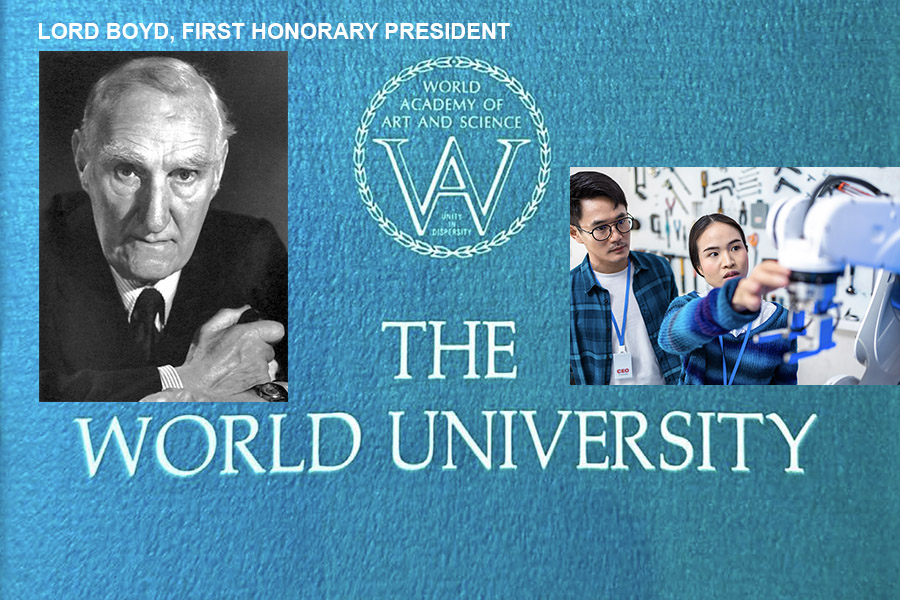
Almost two years ago, in the Yale University archives, I came across a slim teal-colored brochure embossed with a laurel-wreathed W and the words “The World University” (see the original brochure below). It has survived nearly six decades in a cardboard box, one of 56 boxes containing the archives of the World Academy of Art and Science. Its motto, stamped in miniature inside the wreath, reads Unity in Dispersity. Opening it today is a peculiar experience: the paper has yellowed, the typography belongs unmistakably to another era, and yet almost every debate on its pages could have been written today.
The World Academy of Art and Science (WAAS) was founded in 1960 by figures who had watched knowledge outrun wisdom at catastrophic speed — among them Albert Einstein, J. Robert Oppenheimer, Bertrand Russell, and Lord Boyd Orr, the first Director-General of the FAO. From the beginning, its founders were committed to establishing a world university under the auspices of WAAS. The difficulty was never about ambition; it was definition. What, exactly, should such an institution like this be?
The brochure is the answer they arrived at. Its Declaration of Principles opens with a sentence of disarming simplicity: the idea of a world university is to foster the growth of knowledge and to cultivate enlightened judgment in all that concerns the needs and aspirations of humanity. What follows is a design document of remarkable foresight. The University would have no unalterable blueprint. It would supplement, not duplicate, existing institutions. Above all, it would refuse a campus. Today, we would call this being “in the cloud” or “virtual.”
That refusal was deliberate and, in 1968, close to heretical. A world university, the Declaration argues, must not become a religion with a Holy Place, nor an instrument of cultural imbalance. Rather than erect a single monumental headquarters, it would operate through dispersed “primary units” and “cooperating centers” around the globe — institutes, departments, schools, and programs already doing serious work, linked into a common framework. The founders were candid about why: the convenience of central officials favors centralization, and a grand edifice with a large staff flatters the self-image of those who run it. Better, they concluded, to strengthen the whole than to aggrandize the instrument.
The people assembled behind this idea reads like a census of mid-century intellectual life. Harold D. Lasswell of Yale chaired the Executive Committee. The Council included Linus Pauling, Robert M. Hutchins, Sir John Eccles, Hermann J. Muller, Albert Szent-Györgyi, Prasanta Chandra Mahalanobis, and Choh-Ming Li. The first cooperating centers were as improbably specific as they were global: saline irrigation and water purification in Rehovot, microbiological engineering at the Karolinska Institute, fluctuating phenomena at the University of Florence.
The mechanisms proposed were equally inventive. Travelling Fellows would move between centers, carrying with them the questions specialists rarely ask of themselves — a legal scholar embedded among microbiologists to think through what that science would mean for public policy. Commissions would function as task forces on emerging or neglected problems. One anticipated the large-scale pollution of soil, water, and air. Another proposed a Commission on Genetic Engineering and Public Policy, observing that scientific advance in genetics was accelerating and that fundamental questions of public policy could not be deferred indefinitely. That was written more than half a century before the debates now unfolding.
Two priorities framed everything: security, meaning the elimination of war and of scarcities arising from food-population imbalance, and freedom, meaning the protection of wide areas of responsible choice from erosion by biological or cultural engineering.
Then history intervened. A world divided by the Cold War proved inhospitable to a transnational university without borders, and the detailed record of the World University in the decades that followed thinned to almost nothing. The idea did not fail so much as to arrive too early.
It returned in 2013, when WAAS and a group of partner institutions established the World University Consortium to pursue the same vision under contemporary conditions — accessible, affordable, quality higher education worldwide, built on a human-centered approach that shifts emphasis from specialized expertise to contextualized, transdisciplinary knowledge. The vocabulary had modernized; the argument had not changed.
Now, in 2026, WUC enters a new chapter. Its new Board has elected Alberto Zucconi as President and unanimously appointed Irina Bokova, former Director-General of UNESCO, as Honorary President.
These appointments follow the passing of Federico Mayor, whose visionary leadership and lifelong commitment to peace, education, human rights, and sustainable development profoundly shaped the Consortium. His legacy continues to guide WUC’s work to advance higher education as a catalyst for human development and global transformation. Bokova brings exceptional international leadership and a deep commitment to education, science, culture, and cooperation. At UNESCO she championed inclusive education, cultural-heritage protection, and the role of knowledge and innovation in building more peaceful, equitable, and sustainable societies — a record that aligns closely with WUC’s values, and the Board warmly welcomes her to this distinguished role.
The Board also announced that Ralph Wolff, former WUC President and a leading expert in higher-education quality assurance, has accepted the role of Director of Certification for the WUC Certification Program. Building on the seven Future of Education Conferences convened by WAAS and WUC, the program is progressing in India and now preparing to expand across all five continents.
To support that expansion, the Person-Centered Approach Institute (IACP) Department of Artificial Intelligence and Quantum Computing will develop an AI-powered chatbot to assist institutions and organizations applying for WUC certification. Beyond simplifying the process, it will help institutions embed WUC’s core values and quality-learning principles — critical thinking, human rights, human security, and student- and people-centered participatory learning.
A university with no campus, run from everywhere at once, was never a limitation the founders accepted reluctantly. It was the point — and with technology, AI and modern communications, it’s only now becoming possible to build.