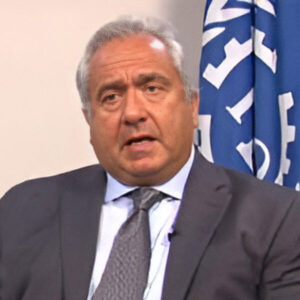
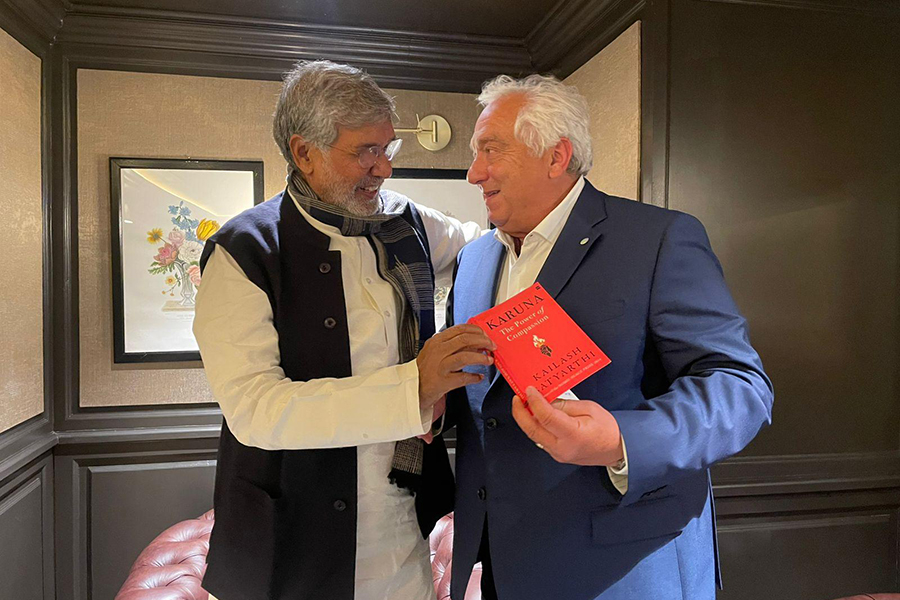
On May 5th, 2026 I find myself on a train, for a one-day trip to Milan to meet with Kailash Satyarthi, a Nobel Peace laureate who for the past five decades has fought for the rights and dignity of millions of dispossessed and marginalized people across the globe.
Three hours of one-on-one conversation covered the mission of the World Academy of Art and Science, its history and achievements, as well as the shared vision and intent between our organization and the “Satyarthi Movement for Global Compassion.” We discussed mutual orientations and compelling stories, including Satyarthi’s extraordinary 80,000 KM walk across 103 countries to campaign against child labour—a journey that culminated in Geneva in 1998 with the adoption of an unprecedented international convention banning slavery, bondage, and the worst forms of child exploitation.
The man who embraces me upon arrival in his hotel lobby and calls me brother has recently applied, with exceptional modesty, to become a fellow of the World Academy. In his application, he wrote: “I deeply appreciate [the Academy] for its longstanding commitment to interdisciplinary dialogue and its contribution to shaping forward-looking, human-centred approaches to global development.” He continued, “Through my journey working alongside some of the most vulnerable communities, I came to a simple yet profound realisation: that the challenges confronting humanity cannot be resolved by intellect or power alone but require the transformative force of compassion.”
Karuna is the Sanskrit word for compassion—an inner strength that connects people through feelings and mutual understanding, transcending human boundaries and extending to nature itself. This concept also encompasses compassionate action: taking practical steps to solve problems with a sense of urgency. According to Kailash Satyarthi’s book “Karuna: The Power of Compassion,” leading with compassion requires wisdom, courage, clarity, and conviction.
The inner peace that Satyarthi describes so eloquently and has practiced throughout his life serves as the cornerstone of the sound human relations that the World Academy champions through its programs, particularly the Global Peace Offensive (GPO). It rests upon our ability to connect with one another, explore common ground, and take action with a problem-solving mindset.
It is this shared foundation between the concept of compassion and the multilateral cooperation and reciprocity advocated by the GPO’s theoretical framework that can lead to conflict transformation and lasting human security.
Centered on these concepts of fostering harmony and peacebuilding, we will have the opportunity to engage in meaningful dialogue about the present and future state of world affairs.
All the foundations are in place to engage in a fundamental transformation of the existing international order into a supranational community dedicated to human wellbeing.
My key takeaway from this fortunate encounter with Kailash Satyarthi is that Global Compassion can serve as a powerful instrument for the Global Peace Offensive—an actionable principle that can effectively transform systems of governance, education, business, and technology. This force for good can help ensure that progress remains inclusive, equitable, and aligned with the broader goals of justice, equality, sustainability, and peace.
The reflection process has only just begun—we shall remain in touch!
In the meantime, Kailash Satyarthi’s nomination to the World Academy embodies our shared commitment to advancing human dignity, justice, and peace through collaborative global action.